
Chi-Naaknigewin: How We Govern Through Our Roles and Responsibilities
Big Ideas
- The Anishinaabeg have roles and responsibilities to care for each other as well as the lands, waters and all of creation.
- These roles and responsibilities are outlined in Chi-Naaknigewin and other laws that are part of the governing system of the Anishinaabeg.
- Laws are informed through our interaction with the natural world which includes all life, including animals and plants, throughout the universe.
- When these laws are not followed, disease and other consequences such as climate change occur.
- Following Chi-Naaknigewin through our roles and responsibilities ensures that future generations are able to enjoy a beautiful life.
- Ngo Dwe Waangizid Anishinaabe, meaning One Anishinaabe Family, is the preamble to the Anishinaabe Chi-Naaknigewin. The Anishinaabe Chi-Naaknigewin was developed by the Elders Council for the Anishinabek Nation to establish a governance structure.
Let’s Explore Chi-Naaknigewin
Watch the following videos:
Natural Law
Inaaknigewin with Isaac and Jerry
Ngo Dwe Waangizid Anishinaabe
Discussion Questions
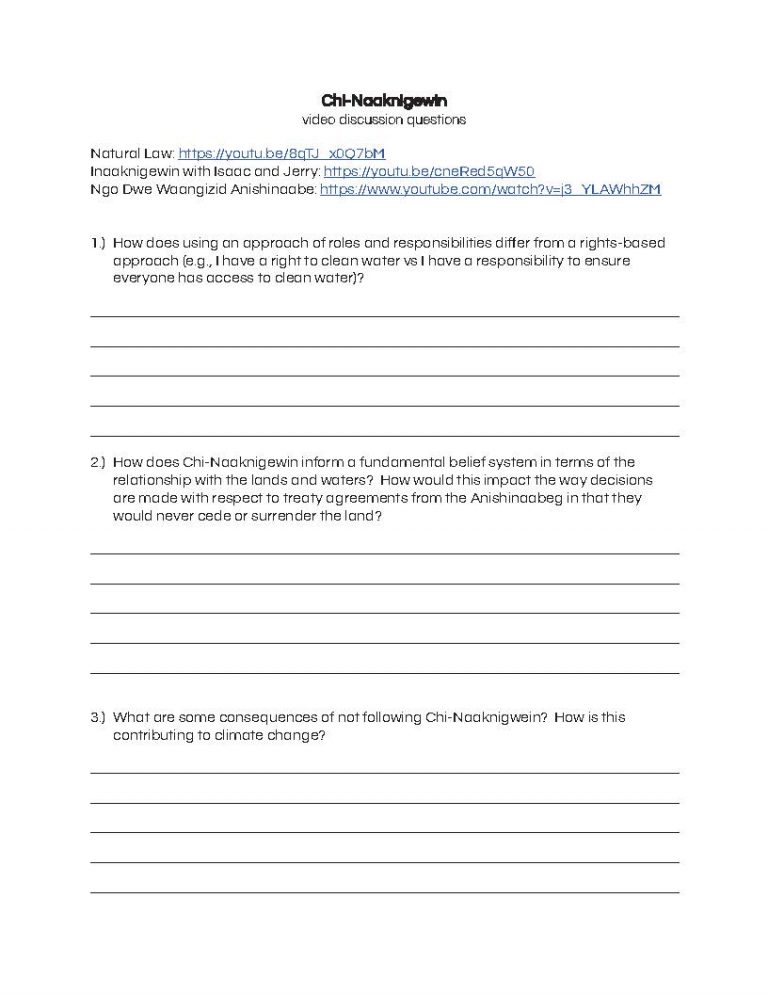
- How does using an approach of roles and responsibilities differ from a rights-based approach?
- How does Chi-Naaknigewin inform a fundamental belief system in terms of the relationship with the lands and waters? How would this impact the way decisions are made with respect to treaty agreements?
- What are some consequences of not following Chi-Naaknigewin? How is this contributing to climate change?
- How is Chi-Naaknigewin in contrast to the ideologies and practices of big corporations? How does this impact the environment?
 Download the fillable discussion questions PDF
Let’s Explore Connecting Colonialism to Climate Change
Watch the following video:
 Download the fillable discussion questions PDF
Consider the Following
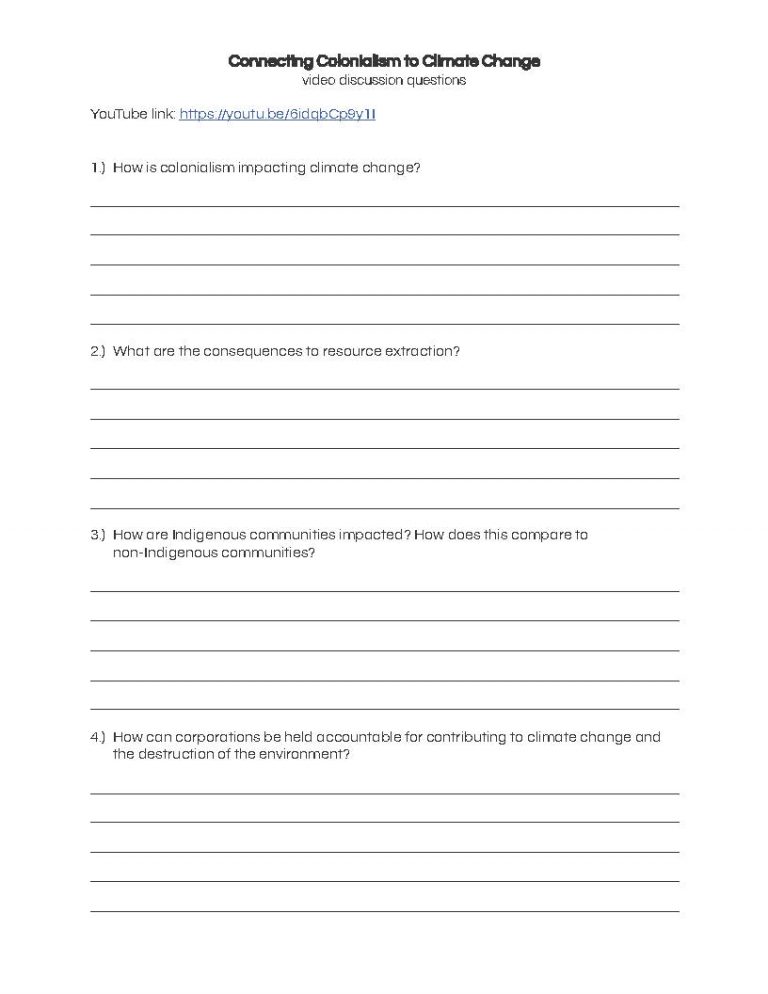
- How is colonialism impacting climate change?
- What are the consequences to resource extraction? How are Indigenous communities impacted? How does this compare to non-Indigenous communities?
- How can corporations be held accountable for contributing to climate change and the destruction of the environment?
Investigate the Impacts of Resource Extraction
Over a series of lessons, expose students to Indigenous perspectives on the relationship to the land. At the same time, students can investigate environmental issues relating to resource extraction in Canada, such as mining, fracking and drilling for oil.
Throughout their investigations, students should be encouraged to explore concepts around rights versus responsibilities.
Questions Around Rights and Responsibilities
- Do we have the right to extract resources as we see fit?
- Should the environment have rights that are protected?
- Should animals, plants and water have rights?
- How can we ensure those are protected?
Guiding Questions for Student Investigation
- What is the direct and potential impact on the environment?
- What is the company’s justification for the need of the resource?
- What is the company’s counter argument regarding environmental impact?
- What is the mitigation plan?
- How do they propose to clean up after they are done?
- What is the company’s corporate social responsibility policy?
- If a company violates environmental laws or causes damage, how are they held accountable?
- How are First Nations communities consulted prior to beginning work?
- What are the federal and provincial governments' involvement?
- Does this conflict with Indigenous views on land use?
- How does the resource project impact local First Nation communities?
Ways Students Can Demonstrate Learning
- Multi-media presentation such as a poster board, brochure, PowerPoint presentation or interactive essay
- Awareness campaign at the school, community level or beyond
Examples of Environmental Issues Associated with Resource Development
- Grassy Narrows logging and mercury poisoning
- Elsipogtog First Nation and fracking
- Fort Nelson First Nation and fracking
- Tr’ondek Hwech’in, Vuntut Gwitchin First Nation and the First Nation of Nacho Nyak Dun and fracking
- Attawapiskat First Nation and diamond mining
- Serpent River First Nation and uranium mining
- Nishnawbe Aski Nation and mining
- Athabasca Chipewyan First Nation and tar sands
- Poundmaker First Nation and Onion Lake Cree Nation and oil and gas
- Cree Nation of Waswanipi and logging
- Aamjinaang First Nation and chemical valley
This activity is based on material from Lessons from Earth and Beyond .
The Importance of Anishinaabe Giizhigad, June 6
The Anishinabek Nation Grand Council confirmed the Anishinaabe Chi-Naaknigewin on June 6, 2012, in Sheguiandah First Nation by the Pipe Ceremony. This is Anishinaabe Law.
June 6 commemorates the Anishinaabe Chi-Naaknigewin, a commitment to live as Anishinabek. Our entire Anishinaabe worldview is captured in Ngo Dwe Waangizid Anishinaabe, the Preamble to the Anishinaabe Chi-Naaknigewin.
In the Anishinaabe Chi-Naaknigewin document, we state that Anishinaabemowin is our first language. It says that we will govern as Anishinaabe, according to Anishinaabe Laws gifted by the Creator.
The Elders gave us the Preamble to the Anishinaabe Chi-Naaknigewin: Ngo Dwe Waangizid Anishinaabe, which means One Anishinaabe Family. That is Anishinaabe Law.
The Anishinaabe Chi-Naaknigewin is a blueprint to go forward to reclaim and restore Anishinabek, a Nation of People.
“Act Indian, not Indian Act.” – Head Getzit Gordon Waindubence Shiikenh baa
Today, the Anishinabek Nation is a confederation of 39 First Nations representing over 65,000 Anishinaabe people. The Anishinabek Nation Grand Council traces its roots to the Confederacy of Three Fires, made up of the Ojibway (Chippewas), Odawa and Pottawatomi Nations.
Learn more about Anishinaabe Giizhigad