
Broken Promises
Big Ideas
- Land was never ceded or surrendered.
- Promises were made to share the land with the newcomers and allow them to live on Anishinaabeg territories in turn for financial compensation.
- In many places there were to be conditional agreements.
- Lands and waters were stolen through many different ways.
- Doctrine of Discovery was used to justify theft of land and to create Canada.
- Maps were redrawn to erase Indigenous peoples and nations even though they still exist today.
- Moving forward requires everyone working together and re-envisioning new maps, land sharing based on financial compensation and the return of lands.
Let’s Explore
1. Watch the following video:
 Download the fillable PDF with these discussion questions
2. Discussion Questions
Engage in discussion using the following inquiry prompts:
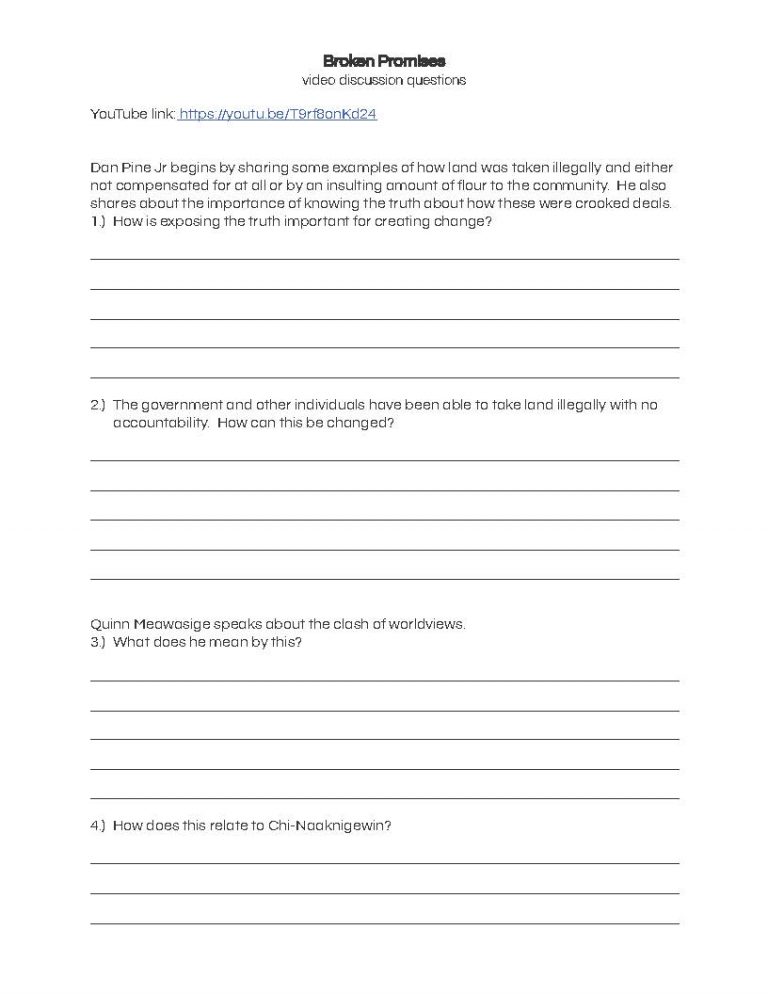
- Don Pine Jr. begins by sharing some examples of how land was taken illegally and either not compensated for at all or by an insulting amount of flour to the community. He also shares about the importance of knowing the truth about how these were criminal deeds.
- How is exposing the truth important for creating change?
- The government and other individuals have been able to take land illegally with no accountability. How can this be changed?
- Quinn Meawasige speaks about the clash of worldviews. What does he mean by this?
- How does this relate to Chi-Naaknigewin?
- How could the government expect the Anishinaabeg to surrender their lands if the concept of ownership was not possible? How did this lead to the government changing its approach to obtaining lands?
- Why has there been no accountability for the illegal theft of lands?
- Indigenous people never relinquished their rights to manage their lands. How does Canada continue to prevent this?
- George Peemquon speaks about how his Grandfather would not sign any treaty. Why did he not want to sign?
- An agreement was to allow people to live in the territory provided they paid rent. Why would the Crown or Canada live up to this agreement?
- George speaks about how difficult it was when using translations when considering treaty signing. Why might the government choose to not include what the Anishinaabeg said?
- How is having the treaties written only in English a problem?
- How does omitting the Anishinaabeg version of the treaty agreements help to enable the theft of lands?
- Isaac Murdoch speaks about stealing land through the redrawing of maps.
- What maps do you learn about in school about this land?
- Why do we only see Canada, the provinces, cities, towns and not the other Indigenous nations such as the Anishinabek Nation that still exist here today?
- What other Indigenous nations have been erased off the map?
- Why would the education system today continue to not show the other nations?
- Why would Indigenous people not be included in the Treaty of Ghent?
- If the border between what is now Canada and the United States was never agreed to by the Anishinaabeg or other Indigenous nations, and it was created on their territory without their consent, why should they be forced to follow this same border?
- How can this be corrected?
- What were the Church or the government behind the Doctrine of Discovery trying to accomplish?
- Why is this a Call to Action (#46) of the Truth and Reconciliation Commission?
- What other Papal Bulls have been used in the same way?
Let’s Explore Further
- Read the document: Cost of Treaties .
- Engage in discussion using the following suggested prompts.
Discussion Prompts
- How does this resonate with the video “Broken Promises”?
- How does hearing from those directly impacted by the government better inform our understanding of Indigenous-Crown relations?
- How can we use this new information to advocate for justice?
Terminology
The following terms and individuals were mentioned in the videos shared during this learning module. You are encouraged to further explore their meaning and impact.
Indian Agent
Shingwauk
Queen Victoria
Crown
Doctrine of Discovery
Treaty of Ghent