
Robinson Huron Treaty
Big Ideas
- The Robinson Huron Treaty signed in 1850 outlines an agreement for sharing land and resources.
- The First Nations in the Treaty territory did not surrender their land, but agreed to share it in exchange for an annual payment from any resource revenue in the territory.
- An escalator provision was included in the Treaty to anticipate annuity increases when resource revenues increased.
- Despite the billions of dollars in revenue from various resources taken from the territory, the annual payment has not changed since 1874 and still remains only $4.
- All Anishinabek members of the treaty were to have unrestricted access to hunt and fish as they always had throughout their traditional territories.
Let’s Explore
Watch the following videos and use the questions provided to guide a discussion with students.
1 Treaty of Niagara
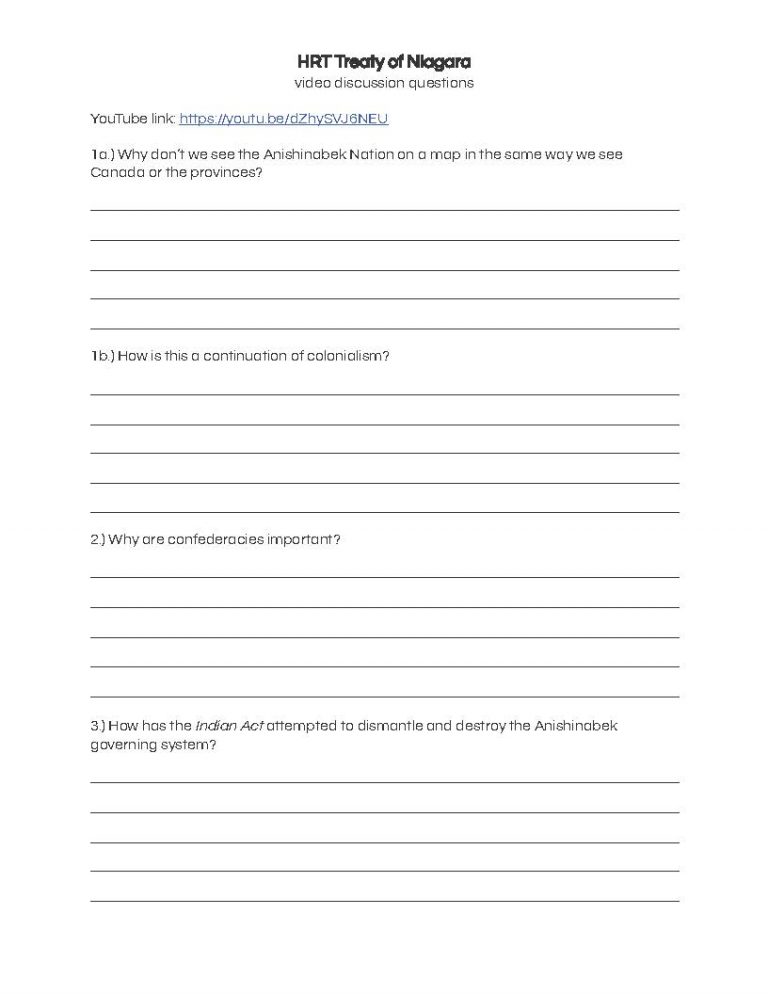 Download the fillable discussion questions PDF
Discussion Questions
- What happened at the Treaty of Paris after Britain defeated France in the war?
- When the Crown requested to meet with the Indigenous nations, approximately how many tribes were in attendance at the meeting?
- What was significant about the statement that the Crown issued in 1763 with respect to the First Nations and new settlement?
- What year did the Treaty of Niagara take place?
- What did William Johnson promise during the Treaty of Niagara?
- How does this relate to the Robinson Huron Treaty?
2 Duke Peltier on the Robinson Huron Treaty
Discussion Questions
- What was happening just prior to the Robinson Huron Treaty that caused concern within the Anishinabek leadership? Where was this taking place?
- What happened at Mica Bay? What did the Anishinabek do? How did the mining company respond? How did the Crown government respond?
- What was the significance of Baawaating (Sault Ste. Marie)?
- What were the terms of the treaty by the Anishinabek?
- What were some of the rules for treaty making outlined by the Royal Proclamation?
- Did the treaty cede or surrender the land?
- What does Ogimaa Duke Peltier hope for in the future?
3 Mike Restoule on the Robinson Huron Treaty
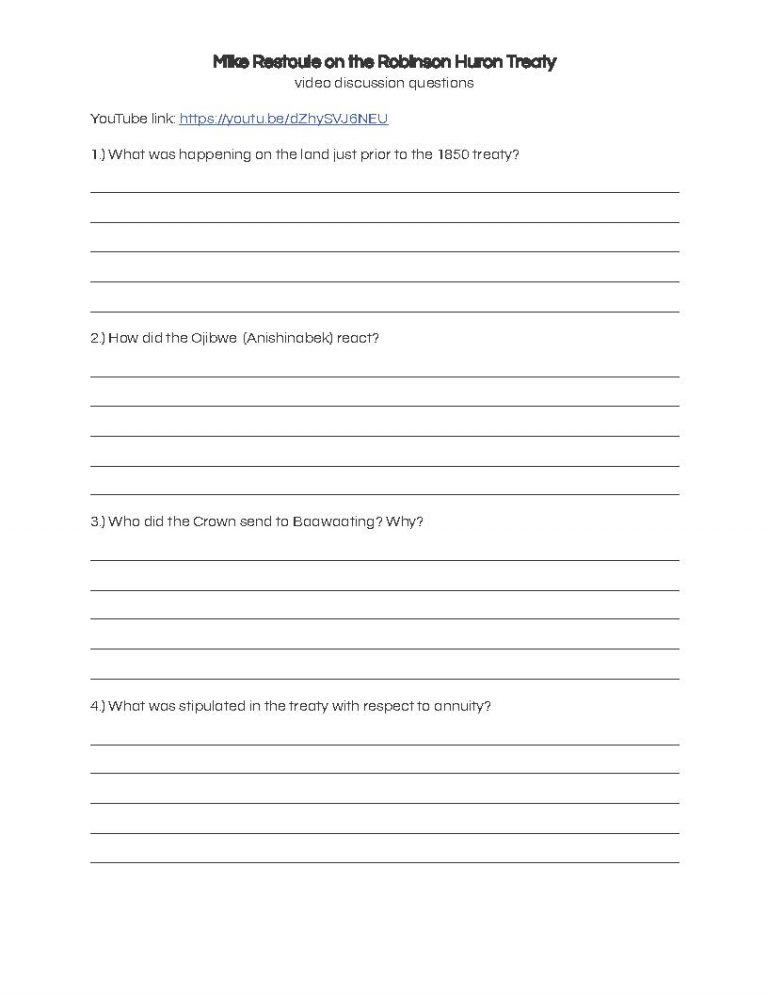 Download the fillable discussion questions PDF
Discussion Questions
- What was happening on the land just prior to the 1850 treaty?
- How did the Ojibway (Anishinabek) react?
- Who did the Crown send to Baawaating? Why?
- What was stipulated in the treaty with respect to annuity?
4 Mike Restoule on Litigation of the Robinson Huron Treaty
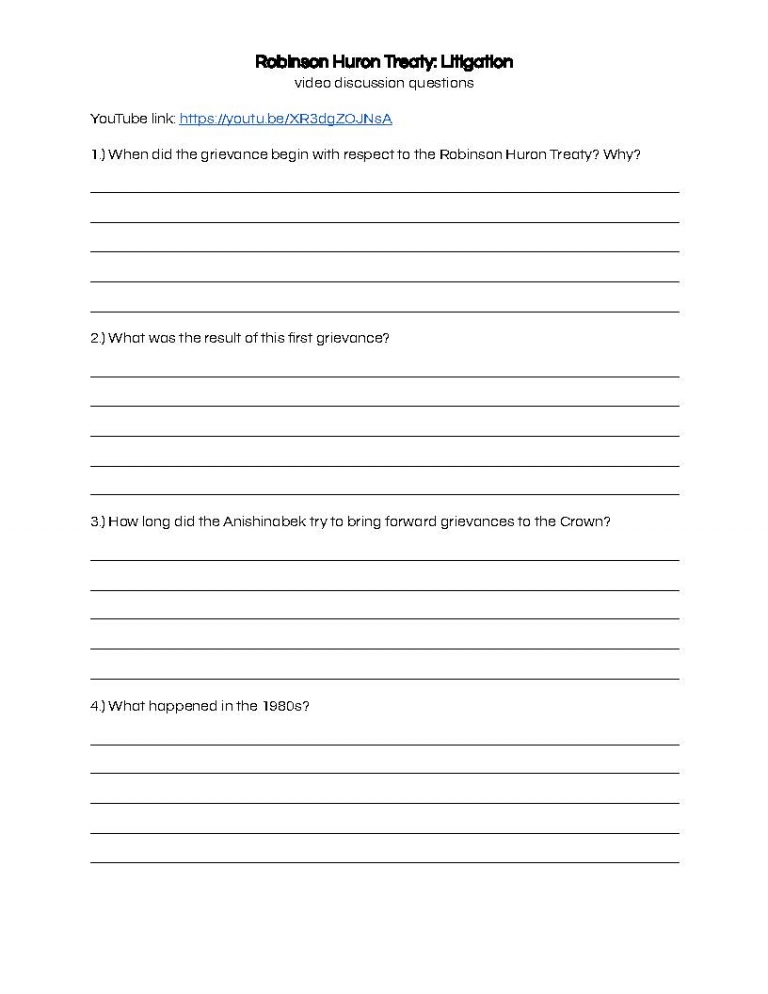 Download the fillable discussion questions PDF
Discussion Questions
- When did the grievance begin with respect to the Robinson Huron Treaty? Why?
- What was the result of this first grievance?
- How long did the Anishinaabek try to bring forward grievances to the Crown?
- What happened in the 1980s?
- Who is part of the Robinson Huron Treaty Annuities Litigation Fund?
- Approximately how many beneficiaries are there?
- Why would the Crown not increase annuity payments even though it was a contractual agreement within the treaty?
- Look up the treaty territory on a map and consider what mining or other resources were being taken from this territory. Since 1850, how much money has the Crown/Canada profited from while only paying the Anishinabek $4 per year in return?
5 Mike Restoule on Court Proceedings
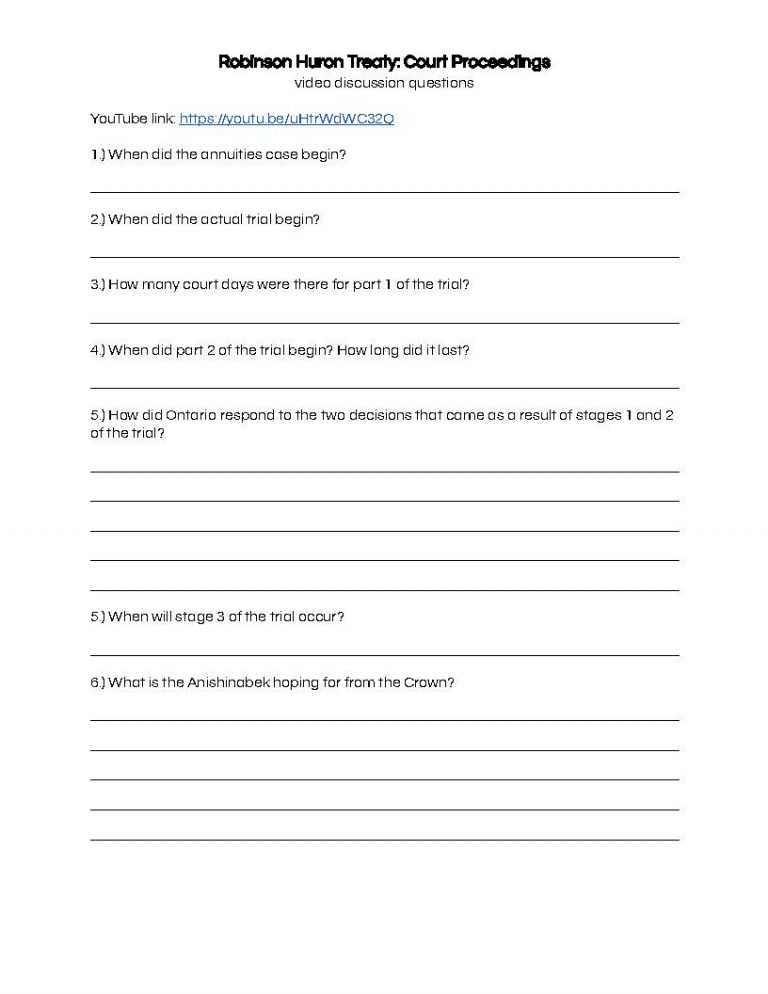 Download the fillable discussion questions PDF
Discussion Questions
- When did the annuities case begin?
- When did the actual trial begin?
- How many court days were there for part 1 of the trial?
- When did part 2 of the trial begin? How long did it last?
- How did Ontario respond to the two decisions that came as a result of stages 1 and 2 of the trial?
- When will stage 3 of the trial occur?
- What is the Anishinabek hoping for from the Crown?
- What are some considerations for the settlement of the treaty?
- At the beginning of the treaty, what amount was the annual annuity per person?
- When did the annuity next get raised? To what amount?
- Has the amount changed since then?
- How might the outcome of the Robinson Huron Treaty case affect other Treaty territories?
- Why is this a unique trial in Canada?
- What was the understanding of the Treaty according to the Anishinaabek in terms of the land? By the Crown changing this to cede and surrender, how would it advance the Crown’s interest in profiting from the resources?
- What is the prime obligation for the Anishinabek under the treaty? How does the Crown violate this?
Additional Resources to Explore
Signed in 1850, the Robinson Huron Treaty outlines an agreement for sharing land and resources.
The annual payment, or annuity, is promised to Treaty beneficiaries, with an augmentation clause that means that as resource revenue grows, so does the payment.
This annual payment brings to life the agreement between First Nations ancestors and the Crown to share the land.
The annuity increased only once, rising from $1.60 to $4 in 1874. It has not changed since.