
First Nation Constitution Building: Chi-Naaknigewin
Big Ideas
- Two key elements of nationhood are the ability to self-govern and self-determine what is best for the nation.
- As the British colonies formed into what is now known as Canada, they created laws to prevent the original nations here from exercising their inherent rights to self-govern and self-determine. This legislation later became the Indian Act and is still in existence today.
- The Anishinaabeg nation, as well as other original nations that pre-exist Canada, differs from Canada in that they have inherent rights due to the fact that they are the original people of this land. These rights cannot be extinguished and supersede colonial laws such as Canadian law.
- Despite centuries of attempted genocide and assimilation by Canada, the Anishinabek Nation has been working to assert its nationhood and reclaim jurisdiction over its lands.
- There are many ways the Anishinaabeg are exercising their laws. One way is through the creation of their own constitution based on Chi-Naaknigewin.
Let’s Explore
1. Watch the following video – First Nation Constitution Building:
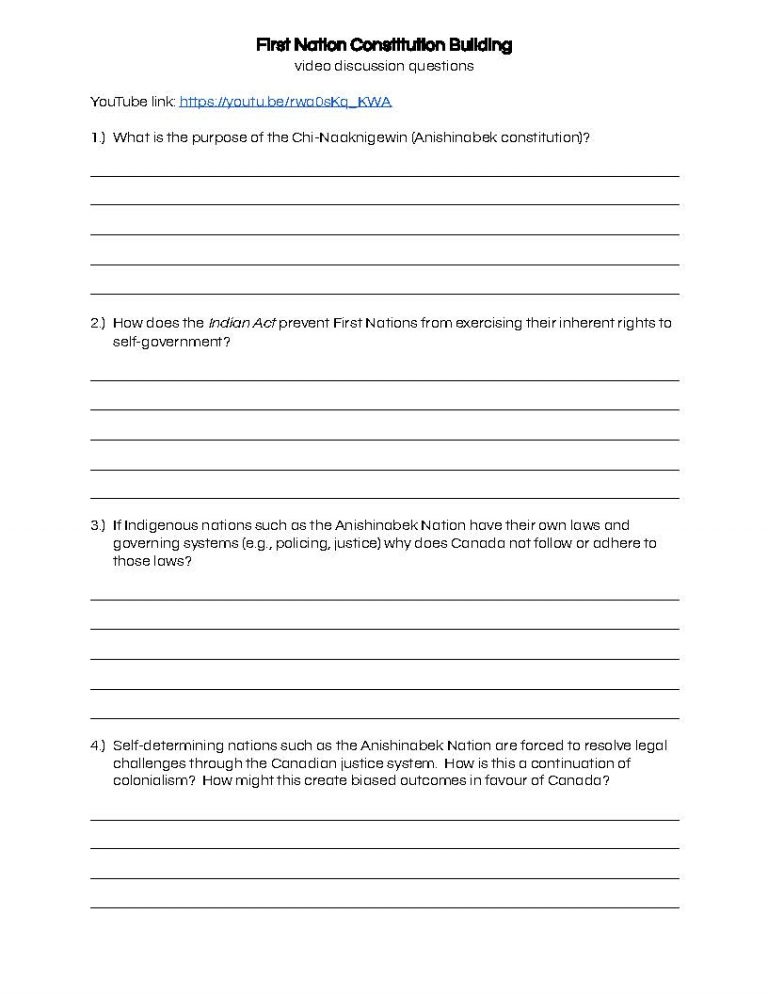 Download the fillable PDF with these discussion questions
Discussion Questions
Either in small groups or as a class, engage in a discussion using these inquiry questions:
- What is the purpose of the Anishinabek constitution?
- How does the Indian Act prevent First Nations from exercising their inherent rights to self-government?
- If Indigenous nations such as the Anishinabek Nation have their own laws and governing systems, such as policing and justice, why does Canada not follow or adhere to those laws?
- Self-determining nations such as the Anishinabek Nation are forced to resolve legal challenges through the Canadian justice system. How is this a continuation of colonialism? How might this create biased outcomes in favour of Canada?
- Everyday Canada breaks its own laws with respect to treaty agreements. How might this be changed so that Canada not only upholds its own laws but also adheres to Anishinabek laws with respect to jurisdiction of Anishinabek lands?
- Chi-Naaknigewin is a reminder of the roles and responsibilities everyone has to ensure a good life for not just the people but for all of creation. This is also to ensure that future generations will experience a good life. How can all peoples, not just the Anishinabek, benefit from following Chi-Naaknigewin?
Activity: Create a Declaration of Responsibilities
- Watch the Inaaknigewin videos.
- Review Ngo Dwe Waangizid Anishinaabe.
- Working in small groups, brainstorm a list of roles and responsibilities for individuals and for the collective group to follow for your class.
- Share your ideas with the whole group to finalize your classroom declaration.
Consider
How might you incorporate key principles outlined in Ngo Dwe Waangizid Anishinaabe as well as Chi-Naaknigewin?
How will you hold each other accountable?
How are rights different from roles and responsibilities?
Note to Teachers
The Anishinabek Nation, as expressed in the video above, is in reference to the Union of Ontario Indians (UOI), the political secretariat for the Anishinabek Nation.
The UOI does not represent all citizens of the Anishinabeg nation. There are many other communities and people who are also Anishinabeg but are not part of this particular political organization.
This is also the same for the political organization Chiefs of Ontario. It is important to recognize that all Anishinabeg have inherent roles and responsibilities that they are entitled to exercise in their territories.
Anishinaabe Governance
Mary Laronde, Temagami First Nation, speaks to Anishinaabe Governance: